
Most SaaS teams believe they have contract management under control. After all, contracts are stored somewhere, renewal dates are “known,” and someone in Legal or Operations can probably find the document if needed.
The problem is that contracts rarely fail loudly.
They fail quietly.
A renewal passes unnoticed.
A notice period expires during a busy quarter.
A customer renews automatically — on terms no longer favorable.
Or worse, a contract is assumed to be active when it has already expired.
By the time anyone realizes something went wrong, the damage is already done.
In fast-growing SaaS companies, this scenario is far more common than teams like to admit.
The Illusion of Control in Growing SaaS Companies
Early-stage SaaS teams manage contracts informally. Sales closes deals, Legal reviews terms, Finance monitors invoices. At small scale, this works — mostly because everyone knows “who to ask.”
But growth changes everything.
More customers mean more variations.
More renewals mean more timelines.
More markets mean more legal complexity.
Spreadsheets grow. Folders multiply. Slack messages replace ownership. Eventually, contracts exist everywhere — and responsibility exists nowhere.
This is not negligence.
It’s structural.
When Renewals Become a Risk, Not an Opportunity
Renewals should be strategic moments: renegotiation, upsell, relationship reset. Instead, in many SaaS companies, they turn into blind spots.
Why?
Because renewals are tracked as dates, not as responsibilities.
A date without context is easy to miss. A reminder without ownership is easy to ignore. When no one is clearly accountable, contracts slip through the cracks during busy sales cycles or product launches.
At scale, “we thought someone else was handling it” becomes the most expensive sentence in the company.
Sales, Legal, and Finance: Same Contract, Different Reality
One of the most underestimated challenges in SaaS contract management is cross-team misalignment.
Sales focuses on speed.
Legal focuses on protection.
Finance focuses on predictability.
All three interact with the same contracts — but with entirely different priorities.
Without a shared system, communication happens through forwarded emails, outdated attachments, and assumptions. Approvals slow down deals. Legal loses visibility. Finance reacts instead of planning.
The issue isn’t collaboration — it’s fragmentation.
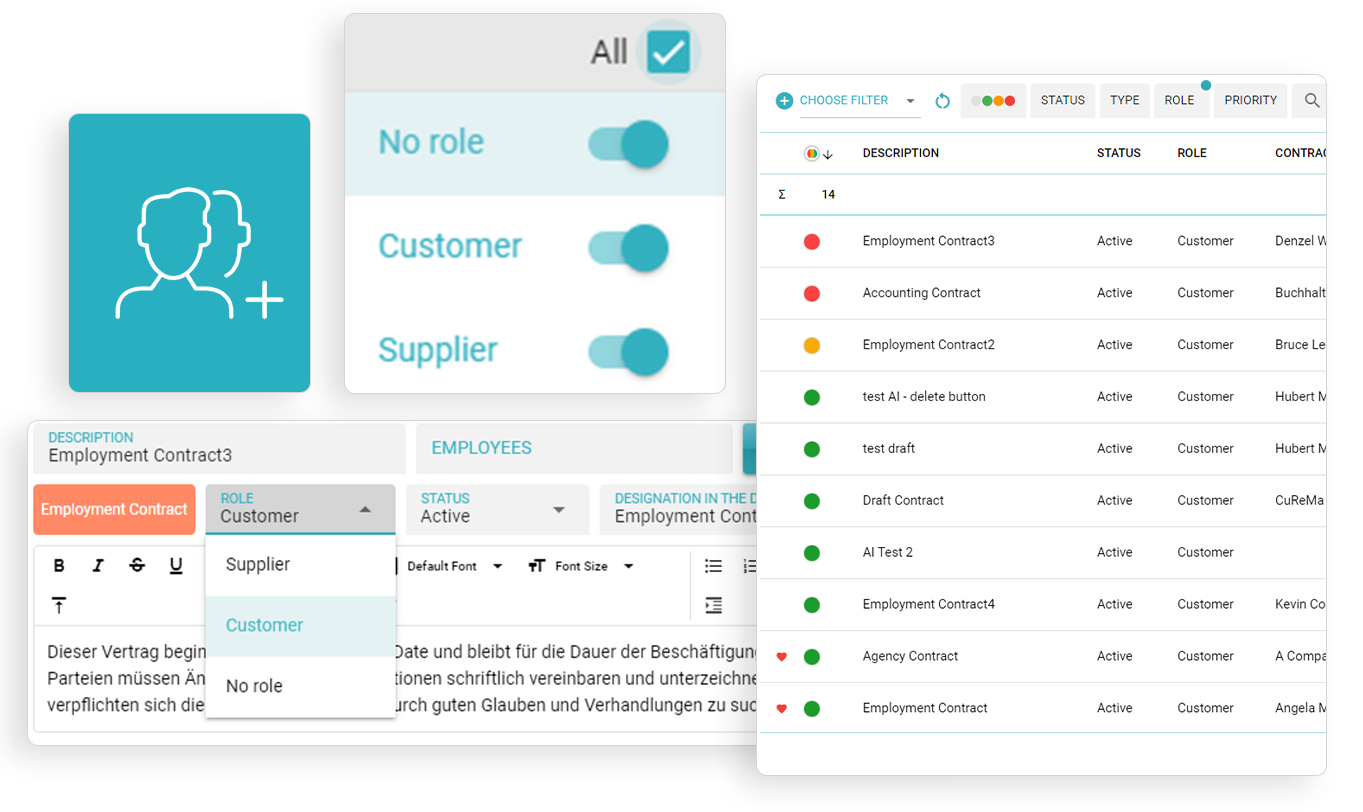
Role-Based Grouping
Easily reach related contracts based on the role.
Group and also list your "no-role" contracts.
The Quiet Cost of Manual Tracking
Most SaaS teams underestimate the operational cost of manual contract tracking.
Time spent searching for agreements.
Uncertainty around the latest version.
Missed notice periods buried in email threads.
Renewals handled reactively instead of proactively.
Individually, these seem manageable. Collectively, they erode margins, trust, and operational confidence.
Manual tracking does not fail overnight.
It fails gradually — and invisibly.
Why Visibility Matters More Than Speed
SaaS companies pride themselves on speed. But speed without visibility creates risk.
Knowing which contracts are active, which are pending, and which are approaching renewal allows teams to act early — not urgently. Visibility transforms renewals from emergencies into decisions.
When every contract has a clear status, owner, and timeline, teams stop firefighting and start planning.
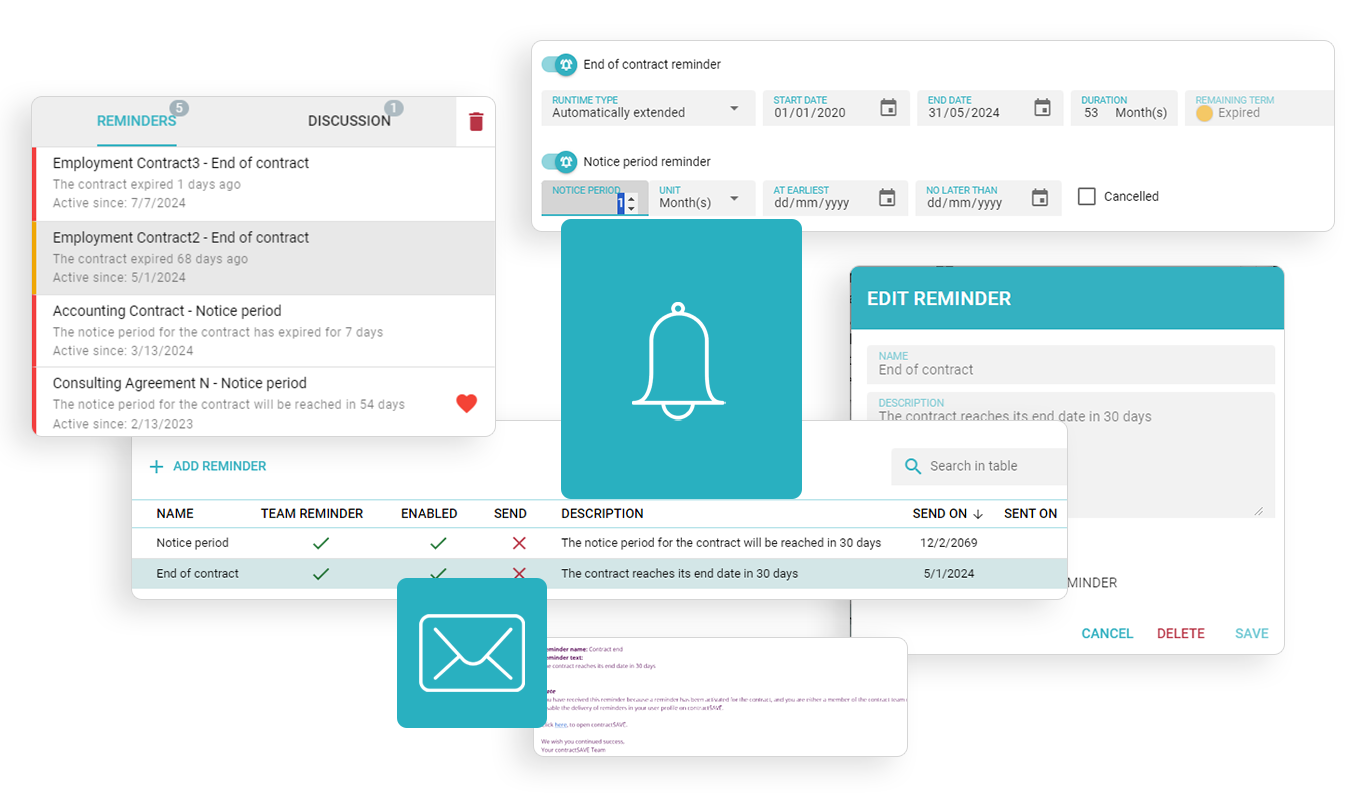
Reminders
Reminders Indicator
Get reminders by email.
Advanced Reminders Feature Ess & Pro
From Scattered Files to a Single Source of Truth
The turning point for many SaaS teams comes when they realize that contract management is not a legal task — it’s an operational foundation.
A centralized system changes how teams work together:
-
Sales closes deals with confidence
-
Legal maintains control without bottlenecks
-
Finance forecasts with accuracy
-
Leadership gains clarity instead of reports built on assumptions
Contracts stop being “documents” and become structured, accessible, and dependable assets.
What Mature SaaS Teams Do Differently
High-performing SaaS organizations don’t manage contracts reactively. They design processes that scale.
They assign ownership.
They standardize visibility.
They replace guesswork with structure.
Most importantly, they stop relying on memory, inboxes, and spreadsheets for something as critical as contractual risk.
FAQs
Why do SaaS companies lose contracts without noticing?
Because renewals and obligations are often tracked informally and without clear ownership.
Isn’t a spreadsheet enough for tracking renewals?
Spreadsheets lack accountability, automation, and real-time visibility at scale.
How do teams avoid missed notice periods?
By assigning ownership and using structured reminders instead of static dates.
Why does cross-team access matter?
Because Sales, Legal, and Finance all depend on the same contract data — in different ways.
When should a SaaS company formalize contract management?
As soon as contract volume and renewal complexity increase beyond manual control.
You might also like