Most revenue teams can tell you this quarter’s pipeline to the decimal. Fewer can tell you how much cash is tied up in contracts you’ve already signed—in the form of unnoticed auto-renewals, missed price escalators, unclaimed rebates, or SLA penalties about to hit the P&L. Those dollars are real, but they’re often invisible: buried in PDFs, scattered across folders, and expressed in language that changes from deal to deal.
This article shows how to expose that value (and risk) with an AI-assisted contract workflow. We’ll define what “hidden” really means, show where the money typically hides, outline a practical extraction + alert pipeline, and give you a 10-day plan to scan 100 contracts and start recovering value. We’ll also cover the CFO metrics that make the business case stick.
What “hidden” means in real life
Hidden doesn’t mean “mysterious”—it means hard to see at the right time. Typical culprits:
-
Auto-renewals & notice windows. Renewal by default unless a party terminates 30/60/90 days in advance. If you miss the window, you pay for another term.
-
Price escalators. CPI-linked increases, step-ups (e.g., +3% year two, +5% year three), floors/caps, FX adjustments, index switches.
-
Rebates & credits. Tiered discounts or rebates that require explicit claims or proof of performance.
-
SLA penalties. Service credits for downtime or response-time misses—often time-boxed and paperwork-heavy.
-
Most Favored Nation (MFN) / Most Favored Customer (MFC). If you give a lower price elsewhere, you owe adjustments here.
-
Audit rights. The right to audit a supplier (or be audited) within set windows—miss it, lose leverage or incur surprise charges.
-
Scope “creep” triggers. Language that turns optional features into billable items after a pilot period, or locks in minimums.
These are scattered across main agreements, annexes, and exhibits, written in inconsistent styles, and sometimes split across multiple paragraphs. The result: high cognitive load at scale—which is exactly where AI can help.
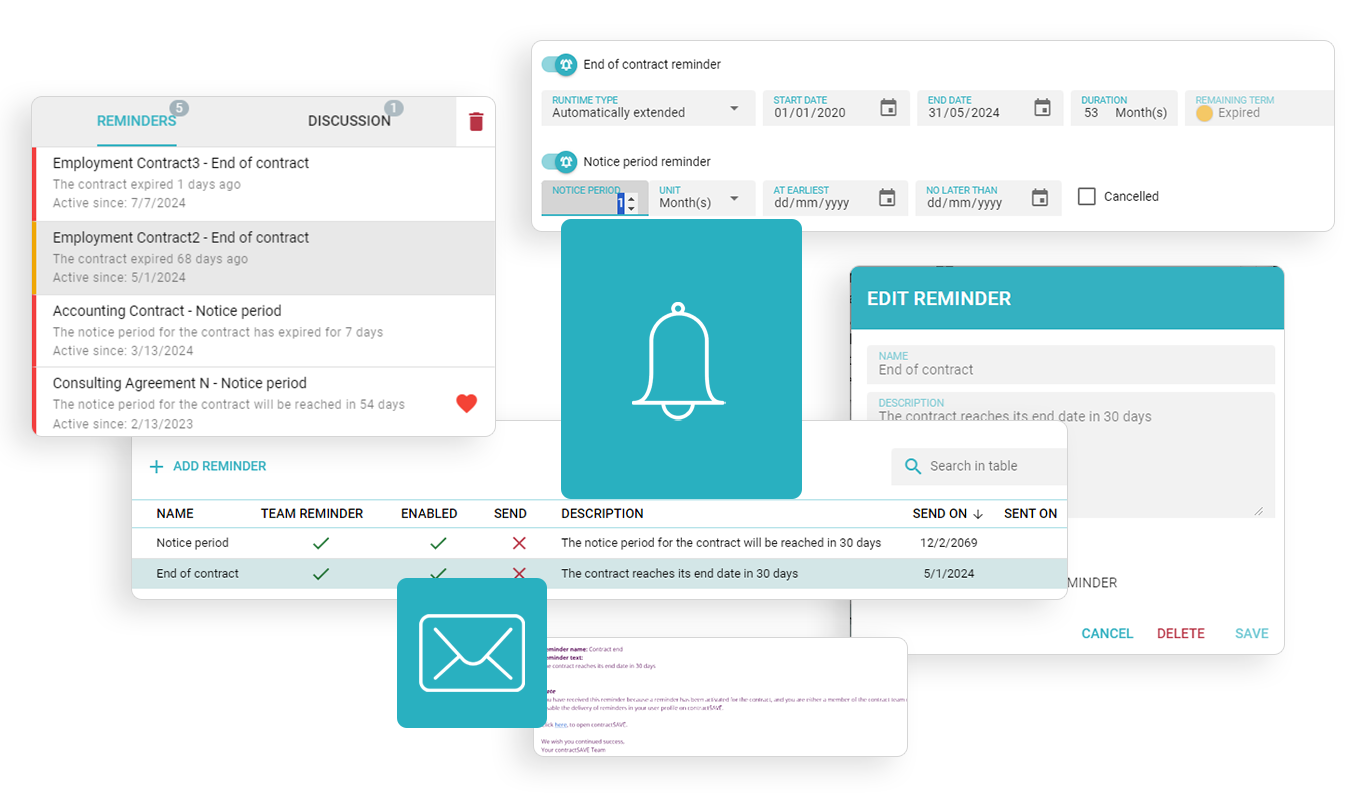
Reminders
Reminders Indicator
Get reminders by email.
Advanced Reminders Feature Ess & Pro
Where money hides: a field guide
Think in two columns: leakage you can prevent vs. value you can capture.
Preventable leakage
-
Unwanted renewals. Missed notice → extra year of spend.
-
Under-billed price escalations. You’re entitled to 3% CPI but didn’t apply it.
-
SLA penalties you owe. A small metrics slip triggers credits to a customer.
-
Over-consumption or off-scope usage. You pay for usage outside baseline because thresholds weren’t monitored.
Capturable value
-
Rebates/credits owed to you. Volume or performance rebates unclaimed.
-
Price escalators due from customers. Legitimate step-ups never invoiced.
-
Audit leverage. Contractual audit rights you can use to correct billing or quality issues.
-
Upsell triggers. Contractual events that green-light additional modules or seats.
Your goal is a single pane of glass that turns each of these into a tracked field with an owner, a date, and a status.
The extraction & alert pipeline (how AI actually helps)
AI doesn’t replace governance; it makes it operational. A robust pipeline looks like this:
-
Ingestion & OCR
-
Pull contracts from email, DMS, e-signature vaults, and shared drives.
-
High-quality OCR converts scans to text; de-skew, de-noise, and detect tables.
-
-
Clause & field identification (LLM + rules)
-
Use models to classify clauses (renewal, notice, CPI, SLA, rebates).
-
Extract fields: renewal term length, notice days, index name, CPI formula, rebate tiers, SLA thresholds, remedy windows.
-
Normalize values: “thirty (30) days” → 30; “CPI-U All Urban Consumers” → CPI_US_U.
-
-
Citations & confidence
-
Every extracted value includes a span highlight (where it came from) and a confidence score.
-
Low confidence → human-in-the-loop queue for verification.
-
-
Policy mapping
-
Map extracted fields to business rules:
-
If notice_days = 60 then create reminder at T-90 and T-65.
-
If cpi_index present then compute next price_increase_date.
-
-
-
Tasks & ownership
-
Create tasks in your CLM (or ticketing system) with owners and due dates.
-
Attach the clause citation so the assignee sees the evidence instantly.
-
-
Dashboards & downstream actions
-
Renewal calendar by counterparty and portfolio.
-
Price-increase schedule with projected revenue.
-
Rebate claims with documentation requirements.
-
SLA risk heat map based on performance data, not just contractual thresholds.
-
-
Governance enablers
-
RBAC so Finance sees pricing without accessing privileged notes.
-
Audit logs for who changed what, when.
-
Data residency & encryption to satisfy compliance teams and customers.
-
This is not a big-bang project; it’s an incremental muscle you build, starting with one contract family and expanding weekly.
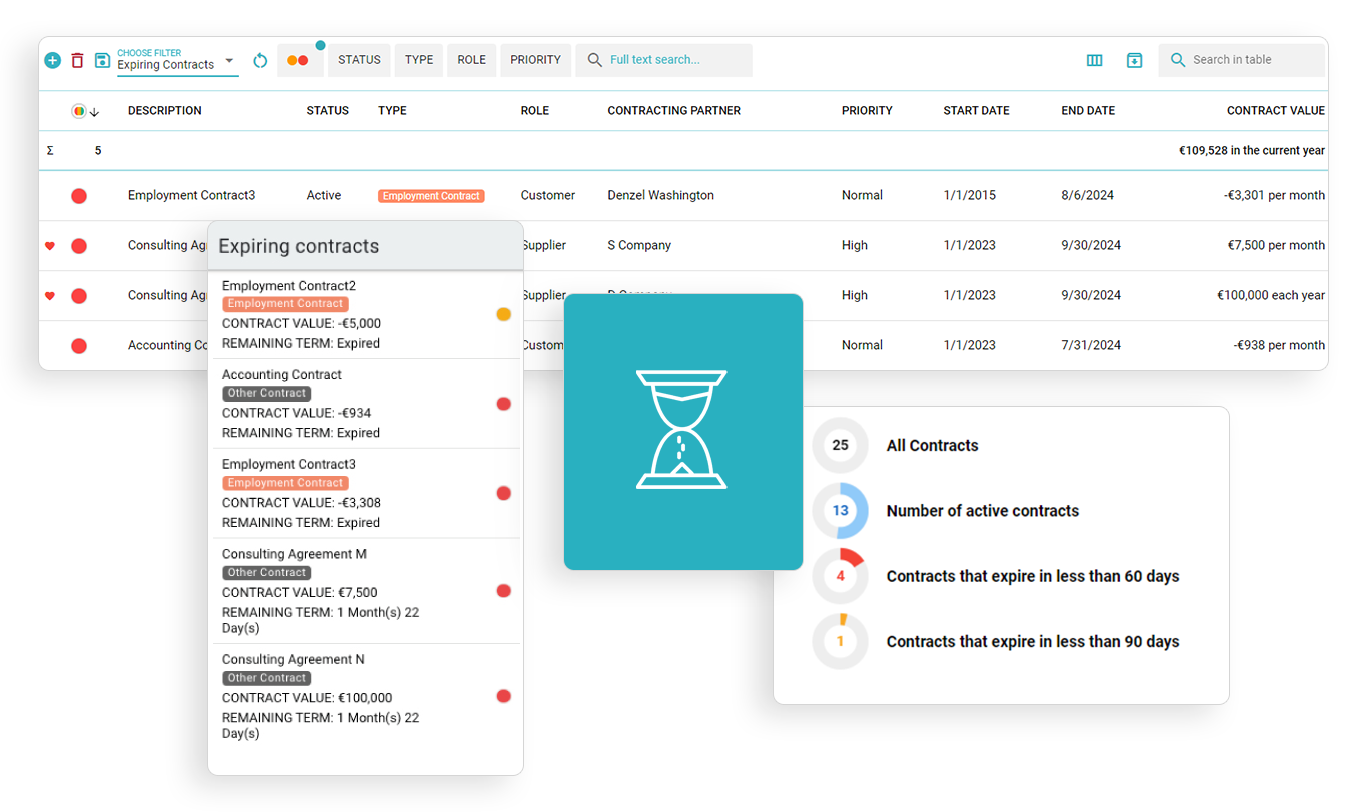
Expiring Information
Check the details of expiring contracts directly.
Reach your expiring contracts with a click.
Designing alerts that people actually act on
Alert fatigue kills value. Design for signal, not noise:
-
Few, meaningful thresholds. Renewals (T-90/T-60/T-30), CPI updates (T-45), rebate claims (T-15) and one weekly digest per owner.
-
Explainable cards. “Vendor ABC auto-renews on Nov 30. Notice due Sep 30. Clause (see citation). Owner: Procurement. Next action: send standard termination template.”
-
Escalations with context. If an owner ignores T-60, notify their manager with a one-click “reassign” option.
-
Attach the playbook. For each alert, include the template email, the calculation method (e.g., CPI formula), and a link to the clause.
CFO dashboard: metrics that prove the money
If you want sustained investment, show outcomes in finance language:
1) Revenue & cost impact (rolling 12 months)
-
Revenue recovered from escalators applied = Σ (new price − old price) × term share.
-
Cost avoided from canceled renewals = Σ (contract value × avoided term).
-
Penalties avoided or recouped via SLA credits = Σ (credit amounts).
2) Compliance & timeliness
-
On-time notice rate = on-time notices ÷ total notices due.
-
Escalator application rate = contracts with escalators properly applied ÷ contracts eligible.
-
Rebate capture rate = rebates filed ÷ rebates available.
3) Process quality
-
Extraction recall/precision for key fields (notice, auto-renewal, CPI). Track over time; aim for recall ≥ 92% on high-risk fields.
-
HITL coverage: % low-confidence items reviewed within SLA (e.g., 48 hours).
-
Time-to-decision on renewal actions from first alert.
4) Forecasting view
-
Upcoming price increases (next 90/180 days) with projected uplift.
-
Expiring obligations (e.g., promotional pricing ending) that may affect churn or renegotiations.
Tie dashboard highlights to bookings and margin to keep leadership focused.
A 10-day quick-win plan (100-contract sprint)
You don’t need perfect coverage to unlock value. Prove it in ten days.
Day 1–2: Assemble the pack
-
100 contracts: a mix of customer and supplier agreements from the last 24 months.
-
Include executed versions and relevant exhibits.
-
Ask Finance/Procurement to nominate deals with known renewals or price-increase clauses.
Day 3: Configure extractors
-
Enable clause types: renewal/notice, CPI/step-ups, rebates, SLAs, MFN.
-
Define normalized fields (e.g., notice_days, renewal_type, cpi_index, escalator_formula, rebate_tiers).
Day 4–5: Run & review
-
Process the pack; route low-confidence items to reviewers.
-
Track precision/recall for the five critical fields; record error types.
Day 6: Wire alerts & owners
-
Create a Renewal Calendar view.
-
For each contract with notice_days, create T-90/T-60/T-30 tasks with assignees.
-
For CPI clauses, compute next increase dates and draft change-notice templates.
Day 7–8: Take action
-
Send termination or renegotiation notices for unwanted renewals.
-
Send CPI adjustment notices where permissible.
-
File at least two rebate claims with proper documentation.
Day 9: Quantify the win
-
Dollars avoided (cancelled renewals) + dollars uplifted (escalators) − any credits owed.
-
Time saved vs. manual search (ask reviewers to log minutes).
Day 10: Executive summary
-
One-pager with dollars, precision/recall, and a 60-day rollout plan.
-
Propose ongoing cadence: 50 contracts per week until the backlog is cleared.
This sprint usually pays for itself immediately, which funds broader rollout.
Patterns that make recovery durable
-
Clause libraries & playbooks. Canonical language for renewals, CPI, SLAs; alternatives with risk ratings; negotiation notes.
-
Template-driven notices. Pre-approved email/letter templates that merge contract data (dates, amounts, contacts).
-
Standardized metadata. Counterparty, contract type, effective/renewal dates, notice periods, governing law—all required fields.
-
Quarterly “harvest” reviews. A scheduled sweep of escalators, rebates, and audit rights coming due.
-
Tight RBAC & external sharing. Vendors see only what they should (e.g., final clauses, not margin schedules) with watermarked, expiring links.
Avoid these pitfalls
-
Digitizing debt. Dumping old PDFs without metadata creates a new junk drawer. Start with the last 12–18 months; backfill as needed.
-
Alert spam. Too many alerts → everything gets ignored. Prioritize money-bearing events.
-
No owners. An alert without a named owner is a wish. Assign at ingestion.
-
Opaque AI. If your system can’t show the clause that triggered an alert, Legal won’t trust it. Insist on span-level citations.
-
One-and-done mindset. Obligations recur. Keep calendars and dashboards live; review weekly.
Example ROI math (illustrative)
-
100 supplier contracts, average annual value $60k.
-
30% have auto-renewal with 60-day notice. Of those, you terminate or renegotiate one-third (10 contracts) at 10% savings → $60k in cost avoided this term.
-
25% have CPI/step-up clauses averaging 3% that were not applied last year; you apply them to 20 contracts of $80k each → $48k uplift.
-
10 contracts include unclaimed rebates averaging $3k → $30k reclaimed.
Total impact this cycle: $138k before considering SLA credits or future terms—often from a single 10-day sprint.
You already own the obligations and opportunities in your contracts. The challenge is seeing them in time. With an AI-assisted pipeline—OCR to lift the text, models to identify and normalize, citations to earn trust, and workflows that create owners and deadlines—you turn static PDFs into living financial instruments. The payoff is immediate: fewer accidental renewals, correctly applied price changes, captured rebates, and fewer SLA surprises. Make the invisible visible, and your contracts will start paying dividends you can measure.
FAQ
1) Can AI really detect notice windows and auto-renewals reliably?
Yes—when paired with good OCR, a clause taxonomy, and human review for low-confidence items. The key is recall: you want the system to surface every likely renewal and then let reviewers confirm. With span citations and confidence thresholds, teams quickly validate results and refine rules.
2) How do we handle CPI escalators when the index or formula changes?
Store the index name, calculation method, and effective dates as structured fields. When indices change (e.g., base year updates), your pricing engine can compute the correct uplift. Always attach the clause citation to the notice you send so counterparties see the contractual basis.
3) We have multilingual contracts—will extraction still work?
It can, if your pipeline includes language-aware OCR and models tuned for those languages. Start by evaluating per language; set stricter confidence thresholds until you build enough training examples. For critical fields like notice days, keep human-in-the-loop until precision/recall meet your bar.
4) What about data privacy and compliance?
Choose a platform that supports EU/Germany hosting if needed, enforces encryption at rest/in transit, and offers RBAC + SSO/MFA so only the right people see sensitive terms. Require exportable, tamper-evident logs and a clear DPA with sub-processor disclosures.
5) How do we keep alerts from overwhelming teams long-term?
Limit alerts to money-bearing events (renewals, price changes, rebates, SLA penalties), batch them into weekly digests, and attach templates and citations so action is one click away. Review alert volume monthly; prune rules that generate noise and add ones that consistently produce measurable outcomes.
You might also like