How to Control Supplier, Vendor, and Customer Agreements at Scale
Retail and e-commerce companies rarely struggle with sales volume.
They struggle with contract volume.
Behind every product listing sits a web of agreements: supplier contracts, distribution agreements, marketplace terms, logistics partnerships, payment provider contracts, promotional agreements, and customer-facing terms.
Individually, these contracts seem manageable.
Collectively, they create one of the most complex contract environments in modern business.
And yet, many retail and e-commerce organizations manage them in ways that do not scale.
Where Contract Complexity Quietly Accumulates
In retail and e-commerce, contracts grow in layers.
New suppliers are added.
New campaigns are launched.
New marketplaces are integrated.
New regions come online.
Each change introduces new contractual obligations — often with different timelines, pricing structures, termination clauses, and service levels.
When these agreements are stored across shared drives, inboxes, and legacy systems, teams lose visibility into what is active, what is expiring, and what has already changed.
The result is not immediate failure.
It is delayed financial and operational risk.
Supplier Agreements: Margin Is Defined by Contracts, Not Products
Retail margins are often decided long before a product reaches the customer.
Supplier contracts define pricing tiers, rebates, exclusivity, minimum order quantities, delivery conditions, and penalty clauses. Missing a renewal window or failing to renegotiate terms can quietly erode profitability.
In many organizations, supplier contracts are revisited only when issues arise — not as part of an ongoing operational process.
That reactive approach leaves money on the table.
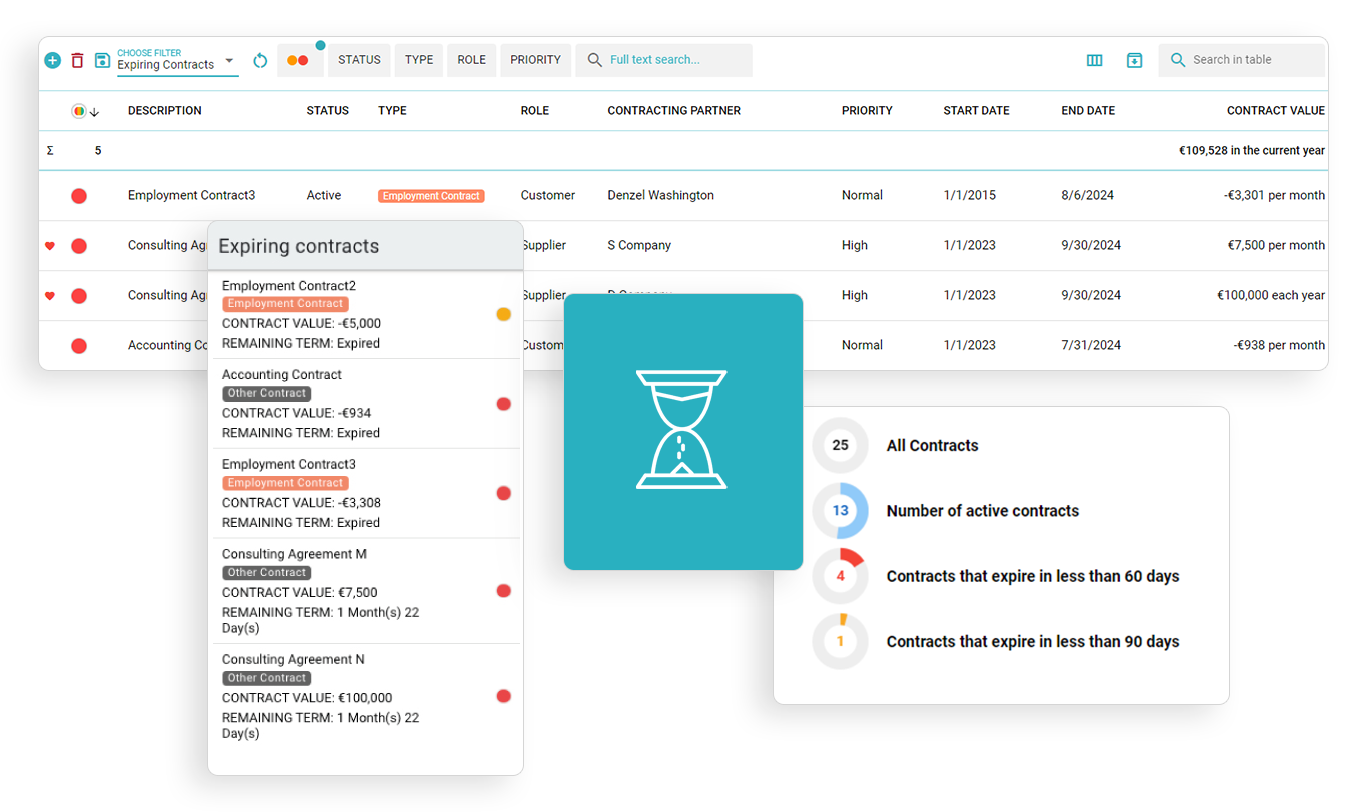
Expiring Information
Check the details of expiring contracts directly.
Reach your expiring contracts with a click.
Marketplaces, Distributors, and the Challenge of Fragmentation
Modern retail operates across multiple channels: owned webshops, third-party marketplaces, distributors, and regional partners.
Each channel comes with its own contract terms, responsibilities, and reporting requirements. Without a unified view, inconsistencies multiply.
Teams struggle to answer simple questions:
-
Which terms apply in which market?
-
Which agreements override others?
-
Which contracts are still valid?
Fragmentation turns contracts into uncertainty.
Customer Contracts: More Than Terms and Conditions
In B2B retail and wholesale, customer contracts often include negotiated pricing, service levels, return conditions, and special clauses that go far beyond standard terms.
When these agreements are not clearly linked to customers and orders, disputes become more likely. Sales teams make promises without full visibility. Operations delivers based on assumptions rather than obligations.
Clear structure prevents conflict before it escalates.
When Renewals Become Invisible
Retail and e-commerce contracts rarely end dramatically. They end quietly — or worse, they renew quietly.
Automatic renewals on outdated logistics agreements.
Marketing partnerships extended without performance review.
Payment provider terms continuing long after fees could have been renegotiated.
Without structured tracking, renewals happen by default, not by decision.
Ownership Across Procurement, Legal, and Operations
Retail contracts touch many teams. Procurement negotiates. Legal reviews. Operations executes. Finance reconciles.
When ownership is unclear, accountability disappears. Everyone assumes someone else is monitoring the contract lifecycle.
Clear ownership changes behavior. Contracts move from static records to active operational tools.
Audit Readiness in a High-Volume Environment
Retail and e-commerce businesses face audits, compliance checks, and partner reviews across multiple regions and platforms.
When contract history is fragmented, responding to audits consumes time and resources. Missing documents weaken positions and damage trust.
Audit readiness depends on traceability — not memory.

Contract Audit
Reach the related contract with a click.
Search and download (CSV format). Pro Version
From Reactive Management to Commercial Control
Leading retail organizations treat contract management as part of commercial strategy.
They don’t wait for disputes, supplier conflicts, or margin erosion to surface issues. They design systems that make obligations, deadlines, and responsibilities visible.
Contracts stop being files.
They become levers of control.
FAQs
Why are retail and e-commerce contracts so complex?
Because they span suppliers, marketplaces, logistics, payments, and customers simultaneously.
Why do renewals often go unnoticed?
Because contracts are tracked as documents, not as ongoing obligations.
How do supplier contracts impact margins?
They define pricing, rebates, and penalties long before products are sold.
Why is ownership critical?
Without clear responsibility, contracts drift through the organization unmanaged.
When should retail companies formalize contract management?
As soon as supplier and channel complexity increases beyond manual tracking.
You might also like